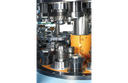
Automatic Vertical Spin Flow Necker, Flanger with Twin Seamers Machine(For Aerosol Can)

S-B93
https://www.shinican.com/web/image/product.template/74/image_1920?unique=55011de

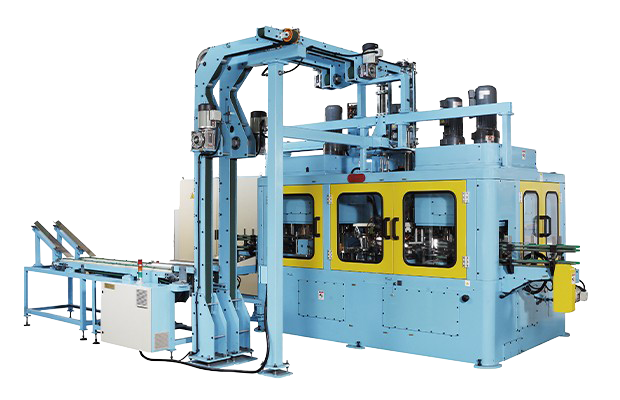
The S-B93 combines spin flow necking, flanging, and twin seaming in one vertical four-station machine, giving aerosol can manufacturers wrinkle-free necking on hard DR tinplate at speeds up to 400 cans per minute.

400

Cans per minute

4

Stations in one machine

45 to 73 mm

Can diameter range

Key production advantages

  • Spin flow rollers neck hard DR tinplate without wrinkling
  • Necking, flanging, and twin seaming in one vertical line
  • Motor-driven height adjustment for fast size changeover
  • Centralized lubrication cuts maintenance downtime
  • Manufactured in Taiwan. Serving factories in 80 countries.

    This combination does not exist.

    Overview

    Built for the hard tinplate challenge in aerosol can production

    What challenge does this machine address?

    Aerosol can manufacturers in South and Southeast Asia, Latin America, and the Middle East face a shared production challenge: necking hard DR (double-reduced) tinplate without wrinkling. DR tinplate is widely specified in these markets because it costs less per unit and offers higher strength than single-reduced grades. Its reduced ductility, however, makes conventional necking methods more prone to wrinkling, elevated scrap rates, and inconsistent seam quality.

    How does the S-B93 address this?

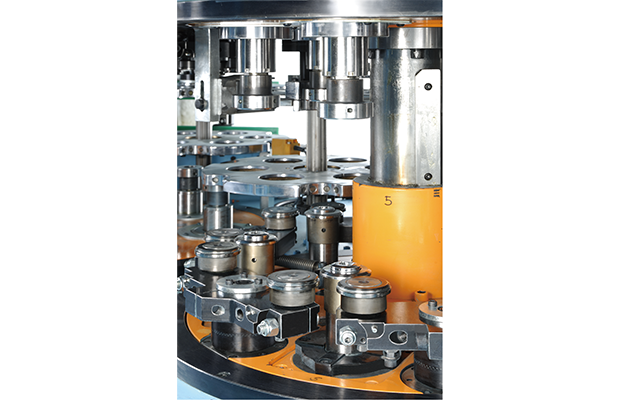
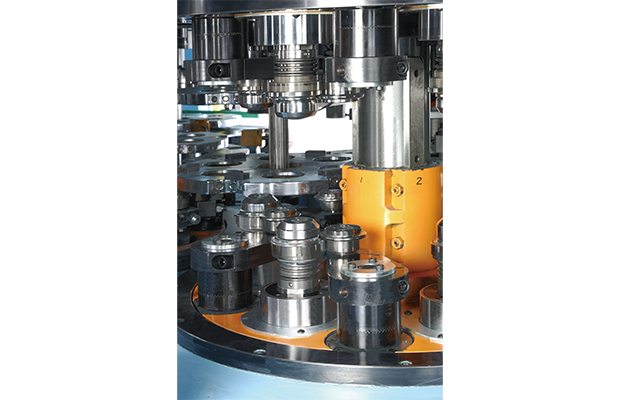
    Stations 1 and 2 use a spin flow roller system that progressively reshapes the can neck through controlled rotational contact. Forming stress distributes evenly around the circumference rather than concentrating at a single contact point, keeping the material within its deformation limit throughout the process. The result is more consistent, wrinkle-free necking across the full diameter range of 45 to 73 mm, including hard DR grades.

    What operations are integrated into the machine?

    Stations 3 and 4 seal bottom and top ends using seaming rollers and chucks, completing necking, flanging, and twin seaming in one compact vertical machine at speeds up to 400 cans per minute.

    Suitable for these aerosol can types

    • 3-piece tinplate aerosol cans, 45 to 73 mm diameter
    • Can height range: 60 to 340 mm
    • Hard DR tinplate and thin tinplate grades
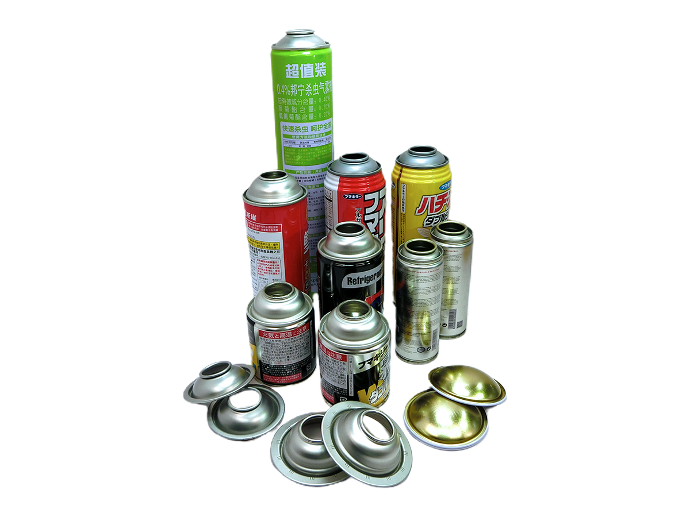
    • Personal care, household, industrial, and automotive spray applications

    Technology

    Spin flow necking versus conventional die necking

    Why does hard DR tinplate wrinkle during conventional necking?

    Conventional die necking pushes a shaped die against the open end of the can cylinder to reduce its diameter in one stroke. On soft or single-reduced tinplate, this works reliably. On hard DR tinplate, the material resists sudden deformation. Steel exceeds its yield point unevenly around the circumference, and the excess material buckles into wrinkles at the neck. These wrinkles weaken the seam area, create inconsistencies in valve fit, and contribute to scrap.

    Why is spin flow necking more suitable for hard DR tinplate?

    Spin flow necking works through progressive contact. A set of forming rollers rotates around the can end, gradually reshaping the neck over a controlled path. Stress distributes more evenly as the neck forms, keeping the material within its deformation limit throughout the process. Hard, thin, and combination-temper tinplate grades can be formed more cleanly without reaching the buckling threshold as in single-stroke die necking.

    Factor Conventional die necking Spin flow necking (S-B93)
    How force is applied Single-stroke die contact, full circumference simultaneously Progressive roller contact, force distributed over rotation path
    Performance on hard DR tinplate Prone to wrinkling and elevated scrap Consistent results, no wrinkling
    Material stress distribution Uneven, peaks at contact points Even, spread over roller travel path
    Suitable tinplate grades Single-reduced (SR) grades SR and DR grades, including thin-wall
    Seam integrity at neck Variable on hard materials Consistent diameter and profile

    Four-Station Sequence

    All four forming operations run in a single inline vertical sequence. Cans move through by turret from station to station without manual transfer between machines.

    Station 1

    Spin Flow Necking

    Forming rollers progressively reduce can diameter at the top end without wrinkling the material

    Spin Flow

    Station 2

    Spin Flow Flanging

    Rollers form the outward flange on the necked end, preparing it for seaming

    Spin Flow

    Station 3

    Bottom End Seaming

    Bottom end is fed from ground-level magazine and sealed by seaming rollers and chuck

    Twin Seamer

    Station 4

    Top End Seaming

    Top end is fed and sealed. Completed cans are carried away by turret.

    Twin Seamer

    Specifications

    Machine specifications

    Specification Value
    Machine type S-B93
    Model type 6H
    Can diameter range 45 to 73 mm
    Can height range 60 to 340 mm
    Capacity Up to 400 cans per minute
    Power required 20 HP x 1, 5 HP x 4, 2 HP x 1, 0.5 HP x 3
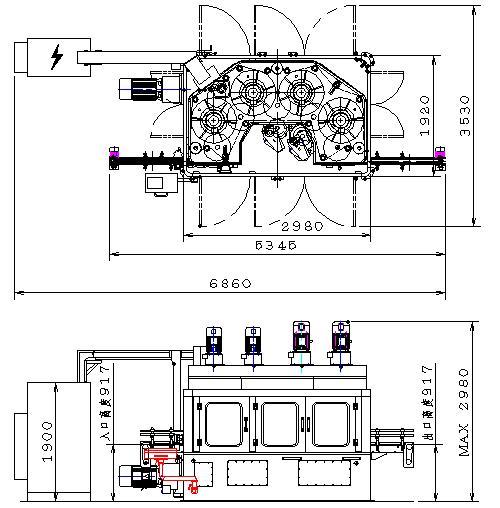
    Floor space (L x W x H) 7,410 x 4,380 x 3,040 mm
    Net weight 13,000 kg

    Production capacity reference: At 400 cans per minute, the S-B93 produces approximately 192,000 cans per 8-hour shift. Running two shifts per day, five days per week, one machine supports annual output of over 90 million cans. This is sufficient for mid-to-large scale aerosol can manufacturers serving regional personal care, household, or industrial markets.

    Variable speed control via inverter allows operators to match line speed during integration with upstream and downstream equipment, or reduce speed during initial production runs after a size changeover.

    Line integration notes

    • Vertical inline design connects directly to upstream body welding lines and downstream filling equipment
    • Ground-level dual-lane end feeding removes the need for elevated magazine platforms
    • Twin spiral separating knives in each end magazine prevent double-feeding
    • Footprint of 7.4 m x 4.4 m consolidates four operations, reducing total line length compared to separate single-function machines

    Features

    Designed for production efficiency and low maintenance cost

    01

    Wrinkle-free necking on hard DR tinplate

    The spin flow roller system at stations 1 and 2 distributes forming stress evenly around the can circumference as the neck forms. This keeps the material within its deformation limit and eliminates wrinkling on hard and thin DR tinplate grades at the forming stage, not through downstream rejection.
    02

    Fast size changeover with digital ruler

    Can height adjustment is motor-driven across all stations. A digital ruler displays the current setting numerically, so operators reset height accurately without manual measurement or trial production runs. This shortens changeover time across the full height range of 60 to 340 mm.

    03

    Recyclable centralized lubrication system

    A single centralized circuit lubricates both upper and lower transmission systems simultaneously on a timed cycle. The system recovers and recirculates lubricant rather than consuming it, which lowers material cost and extends the service interval between maintenance checks compared to individual lubrication points.

    04

    Ground-level dual-lane end feeding

    Top and bottom ends feed from ground-level magazines through two independent lanes, each with twin spiral separating knives to prevent double-feeding. Operators load ends at floor level, removing the need for elevated platforms and reducing the physical demand of end loading during production runs.

    05

    HMI touchscreen with variable speed inverter

    A touchscreen interface provides speed setting, machine status monitoring, and parameter adjustment from a single panel. The inverter-controlled drive system allows production speed to be adjusted during operation, making it straightforward to synchronize the S-B93 with other machines in the line.

    06

    Per-station body turning speed adjustment

    Can body rotation speed is independently adjustable at each of the four stations. Operators can fine-tune forming conditions station by station, which is useful when running at upper speed ranges or when processing material at the harder end of the DR grade spectrum.

    07

    Hard chrome and nylon can guides and turrets

    Turrets and can guides are available in hard chrome-plated steel or nylon depending on the application. Both options maintain dimensional accuracy during high-speed can transfer between stations and withstand the abrasive contact of metal cans over extended production runs.

    08

    Multi-level safety design

    Safety interlocks are built into both the mechanical and electrical systems, protecting machine components and operators if a jam, misfeed, or out-of-specification condition is detected. The safety architecture is designed to meet factory safety standards across international markets.

    Why Shin-I

    Over 60 years manufacturing can-making equipment in Taiwan

    60+

    Years in can-making machinery

    Shin-I has manufactured can-making equipment from its factory in Taichung, Taiwan since 1956. The company started with six employees and now operates a 16,550 square meters production facility with 300 staff, producing a complete range of automatic can production machines for food, beverage, and aerosol applications.

    80+

    Countries served

    Shin-I machines are in production at aerosol and food can factories across Asia, Europe, the Americas, the Middle East, and Africa. This global footprint means Shin-I has direct experience with the material grades, operating conditions, and factory requirements of a wide range of markets and regulatory environments.

    ISO

    9001 quality management

    All machines are produced under an ISO 9001 quality management system covering design, manufacturing, and inspection. Systematic spare parts inventory and overseas technical service support are provided as standard, giving buyers a reliable source of parts and engineering assistance throughout the machine's service life.

    Selecting a machinery supplier for an aerosol can line is a long-term decision. Beyond the machine specification, buyers need to know that components will be available when needed, that installation support is accessible, and that the manufacturer has practical experience with the production speeds and material grades involved in their specific process.

    For buyers comparing Taiwanese and other-origin can-making equipment, the performance differences tend to show in tooling material selection, consistency of formed can dimensions over long production runs, and the durability of transmission systems across varying operating temperatures. Shin-I's track record in these areas has been built across six decades and customer feedback from more than 80 countries.

    FAQ

    Common questions about the S-B93

    What problem does the S-B93 solve?

    It is designed to neck hard DR tinplate without wrinkling, reducing scrap, protecting seam quality, and improving consistency at the necked area of the can.

    How is spin flow necking different from conventional die necking?

    Spin flow necking applies force progressively through rotating rollers over a controlled path. Conventional die necking applies force in a single stroke. Progressive forming distributes stress more evenly and is more suitable for hard DR tinplate.

    What can sizes can this machine handle?

    The S-B93 supports aerosol cans from 45 to 73 mm in diameter and 60 to 340 mm in height.

    What is the maximum production speed?

    The machine operates at up to 400 cans per minute. At this speed it produces approximately 192,000 cans in an 8-hour shift, depending on product, material, tooling, and line conditions.

    What operations are integrated into the machine?

    The S-B93 integrates spin flow necking, flanging, bottom end seaming, and top end seaming in one vertical four-station machine. Cans move by turret between stations without manual transfer.

    Which markets and applications is this machine used for?

    The S-B93 is used by manufacturers producing personal care aerosols, household cleaners and insecticides, and automotive or industrial sprays. It is particularly relevant for factories in India, Indonesia, Vietnam, Brazil, and Turkey where hard DR tinplate is a standard production material.

    Layout Dimension


    VIDEO


    Applications 

    Whether you're a novice or looking to increase production capacity, whether you need to produce food cans or other packaging containers, our professional technical team will collaborate with you to tailor solutions to meet your can production needs.


    將其替換為您自己的 HTML 代碼